
Fractionation
Dry Fractionation is a combination of two classic techniques: a gentle cooling of the oil to temperatures at which the typically more saturated components ‘selectively’ crystallize. Desmet offers the widest range in proprietary crystallizer designs in the industry, suitable for various operation modes and often application-specific.
When the required crystallization degree is obtained, the liquid fraction is separated from the solid crystals by a membrane press filtration. The efficiency of this step largely determines the overall yield balance and final hard fraction quality.
Both the fractional crystallization of the oil and the filtration of the crystals are purely physical processes, and do not require catalysts, chemical reactions not extreme temperatures or pressures.

Mobulizer crystallizers:
the key equipment in iConFrac
A highly selective crystallization can be well achieved in a fully continuous process by the Desmet fractionation process thanks to the use of a specifically designed and patented MoBulizer™ crystallizer, optimized specifically for use in the patented iConFrac™ Technology.
An important difference between the MoBulizer™ crystallizer used for iConFrac™ technology and conventional bulk crystallizers is that crystallization can occur instantly when the oil enters in the crystallizer, while a steady-state plug-flow can be maintained for extremely long periods. It ensures reliability and consistency, as well as superior product quality and unprecedented modes of operation. The 4th generation MoBulizer design accentuates this capacity more than ever through improved draining and automated continuous performance monitoring.

Advantages of Mobulizer
Highest heat exchange efficiency with low shear
Minimized operation costs
High flexibility
No compromises versus batch systems
Tx crystallizer:
a classic design, further improved
The optimized Desmet TX-Crystallizer is characterized by an assembly of cooling pipes and a central axial agitator with specifically designed blades. The temperature of the water circulating through the pipes or fins can be strictly regulated by the integrated control system. This results in a combined gentle agitation of the crystal suspension by the agitator blades, while achieving a very good heat exchange efficiency during the gentle cooling.
An important difference between the TX-crystallizer and a lot of conventional bulk crystallizers is that in the TX-crystallizer, crystallization can occur in a gentle fashion based on oil temperature control across the whole vessel. For specific fractionation applications, this shall offer significant benefits towards the selectivity of the crystallization and the efficiency of the subsequent press filtration.

Advantages of TX-crystallizer
Wide temperature & pressure range
Versatile for various operating conditions
Easy and fast stock change
Customizable process control
Tailored to specific operational needs
Static fractionation with Statolizer Crystallizers for speciality fat
Unlike traditional palm oil fractionation, palm kernel oil fractionation is often confronted with a very rapid crystallization, which cannot be properly controlled in conventional crystallizers. It leads to very high viscosities and insufficient phase separation in the membrane press filter.
Therefore, for this process specifically, Desmet has, through intensive development and global industrial experiences, introduced a proven state-of-art and fully automated PKO dry fractionation process that consists of an efficient crystal initiation followed by a crystal maturation in a patented ‘Statolizer™’- design. The resulting crystal slurry is then conveyed towards a 30barg membrane filter press system, to ensure the purest possible stearin quality for future applications such as cocoa butter substitutes and other speciality fats.
Advantages of Statolizer
Patented static crystallization
High-efficiency cooling with large surface area
High degree of Automization
High Flexibility
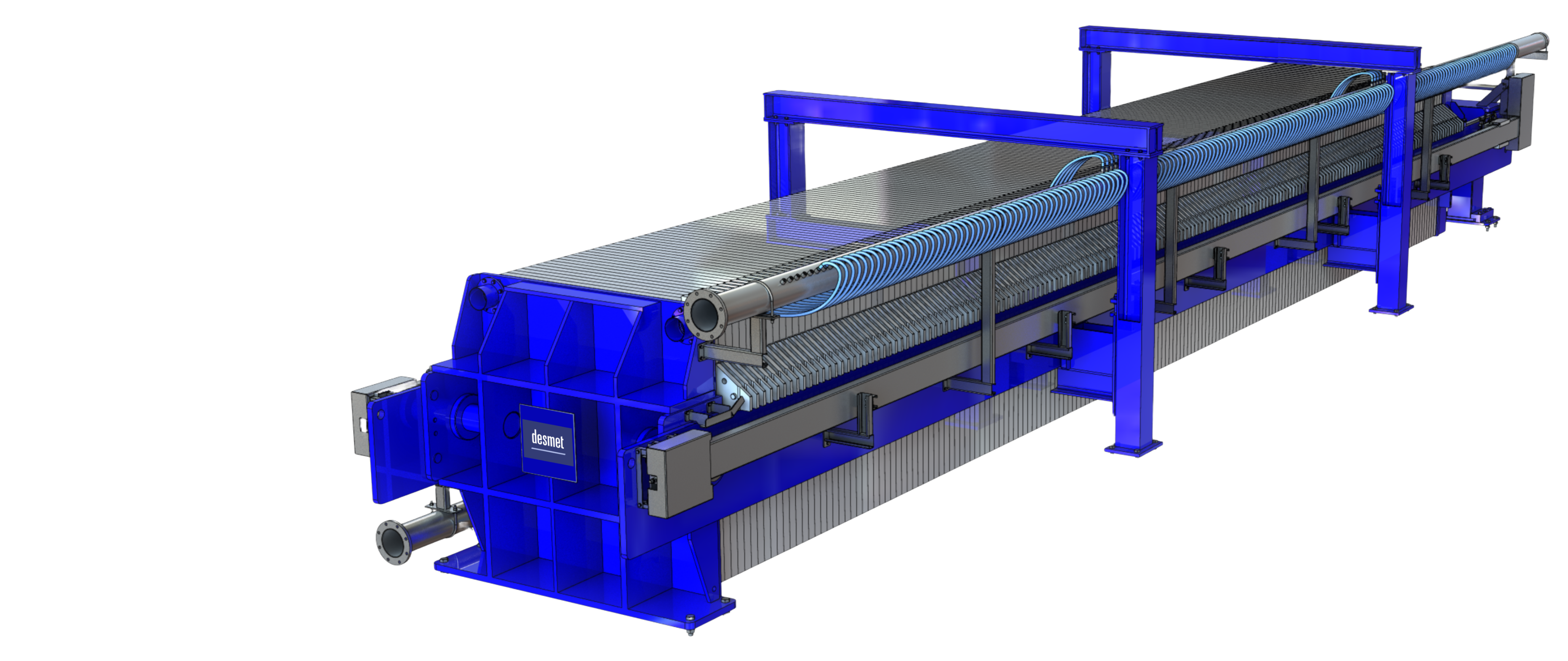
Membrane Press Filter
A staple in any dry fractionation plant, the membrane press filter consists of a horizontal steel frame in which multiple filter plates can be stacked (typically 50 to 200) – each cavity between 2 plates forms a filter chamber, each side draped with filtercloth.
After a filtration of crystal suspensions at lower pressures, the formed filter cake is compacted with pressures up to 15barg, or for superior speciality fats, up to 30barg.
Typically membrane press filters are fully customized to the process and project requirements: material of construction, feed design , cake discharge system, a fully automated plate transport, a proprietary plate design, filter cloth properties,… the membrane filter presses delivered by Desmet are second to none in the fractionation industry, and a guarantee to deliver optimized performance on a daily basis.
