
Sieve Tray Oil Stripper
The purpose of a mineral oil system in a solvent extraction plant is to remove as much of the solvent vapor as possible from the air before it exits the solvent extraction process.

Most of the air enters the extraction system together with the meal at the entrance of the extractor. For a safe operation, the hexane content of the vapours coming out of the mineral oil system should be less then 20% of the lower explosion limit (LEL) of the air mixture. However, as legislation becomes more and more stringent for hexane emissions of the plant the content of hexane in the outgoing air should be as low as possible.
In this respect, Desmet has studied and re-engineered the whole section to obtain optimum results. The solvent vapour absorber, the mineral oil stripper and heat exchangers have been redesigned for optimal absorption and stripping.
The miscella (oil-hexane mixture) needs to be distilled in the distillation section of the extraction plant. The bulk of the hexane is distilled in the first stage evaporator (economizer). But then in the second stage evaporator the oil must be stripped to very low residual hexane content.
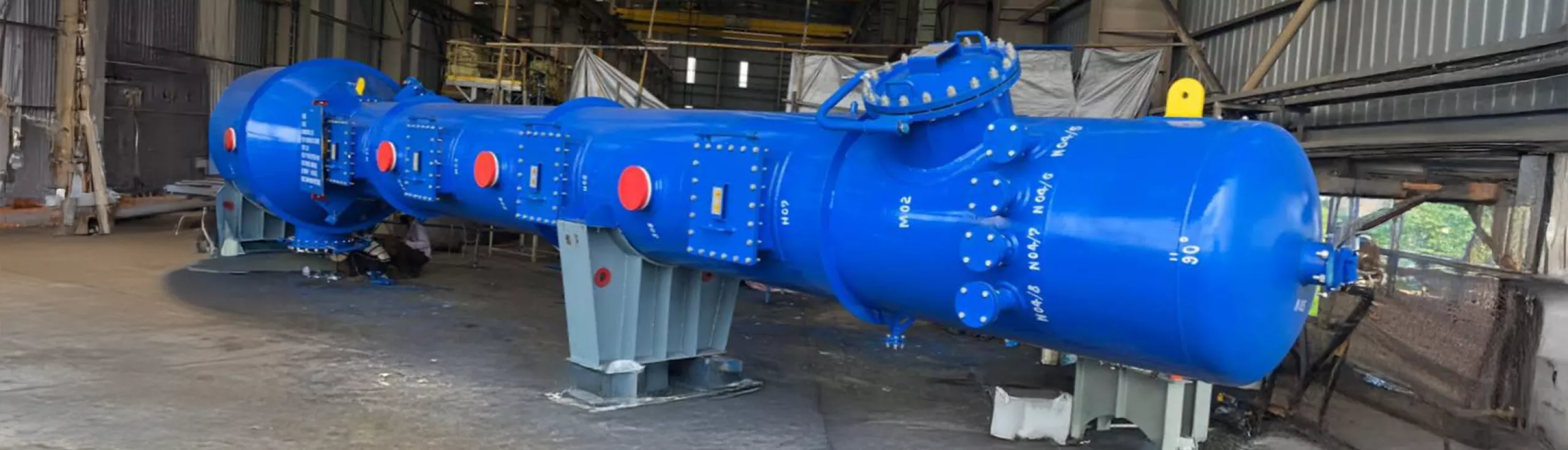
For this position Desmet has designed the sieve tray oil stripper. It is a proprietary design which has several advantages compared to classical oil strippers.
The Sieve Tray Oil Stripper maximizes steam/oil contact , with the oil flowing horizontally across 7 trays in a deep layer while sparging steam passes upward from below. This counter current stripping allows to work at relatively low stripping temperatures (95 to 105°C) while obtaining very low residual hexane content in the stripped oil . Residual hexane is consistently below 10 ppm in the crude oil. This means that hexane losses are minimized in the crude oil. The low stripping temperature also better preserves the quality of the crude oil (less polymers and color components are formed) and this makes the oil safer and easier to handle in a later stage.
As required in a distillation plant, the stripper is a robust construction with large steam passage holes to reduce fouling and also has good maintenance access through wide access doors and removable sparge steam pipes.
The Sieve Tray Oil stripper is running in many plants all over the world and a lot of retrofits have been executed replacing older types of strippers with this more performing type.
How does it work
The concentrated miscella is pumped from the economizer (first stage evaporator) to the sieve tray oil stripper (second stage evaporator). The oil is first heated by heat exchange and then some indirect steam to the stripping temperature of around 100°C.
The miscella is then entering the apparatus tangential in the large dome on top of the stripper. Then the oil flows down by gravity to the sieve trays where the oil is stripped with direct injection steam. The steam passes into the oil through specially designed holes in the sieve tray plates. This creates a very intense contact of the steam with the oil and this allows to reach very low hexane levels (<10 ppm) at relatively low temperatures at the bottom of the stripper.
The oil passes from one tray to the other by overflow and this creates a quite thick layer of oil in each tray. In total each stripper contains 7 sieve tray trays to obtain the desired stripping effect.

Key advantages
Compact vertical design
Robust and maintenance-friendly, saves space
Uniform tray retention time
Ensures consistent product quality