
Fish Oil Processing
Oils produced from fish can be used as a nutraceutical or as an ingredient in both human food and animal feed. Some fish oils are especially valued for their nutritional value. Fish oils may contain high amounts of EPA (Eicosapentaenoic Acid) and DHA (Docosahexaenoic Acid), vital Omega-3 fatty acids that are crucial for our metabolism. Other fish oils can be used in commodity applications. Crude fish oil requires careful processing to meet increasingly strict quality, safety and regulatory requirements.

What does Desmet offer in fish oil processing?
Desmet technology supports producers in maximizing the value of crude fish oil, transforming it into a safe, compliant and market-ready product. Our processing technologies address key challenges such as the reduction of contaminants, including PCBs (polychlorinated biphenyls) and dioxins, while preserving the oil’s nutritional integrity to the fullest extent.
Besides the specifically designed refining and dry fractionation of fish oils, Desmet can also offer more advanced technologies for the further concentration of EPA & DHA.
Full process
This flowchart illustrates the complete fish oil processing route, from crude oil to refined and fractionated products. Each step is designed to maximize product value while ensuring optimal preservation of EPA and DHA, particularly during deodorization.

How does fish oil processing work?
Desmet’s fish oil processing is built around a series of refining and concentration steps that can be combined in one plant, and optimized depending on the quality of the crude fish oil and the intended food or feed application. The objective is to gradually remove unwanted components, while preserving and even concentrating valuable fatty acids.
Chemical refining
In most cases, fish oil is processed through chemical refining, a robust and flexible process that allows effective removal of impurities and free fatty acids (FFA). During this process, unwanted components are eliminated step by step through operations such as neutralization, bleaching and deodorization. This process is indispensable for fish oil processing where EPA and DHA preservation is the main objective.
Physical refining
For fish oils with less emphasis on EPA/DHA, Physical refining can be proposed instead of the chemical route. In physical refining, free fatty acids are removed during the deodorization step by steam stripping, typically resulting in lower product losses, especially for oils with higher FFA levels.
In both cases the refining is specifically adapted to deal with environmental contaminants. Depending on the origin, contaminants such as PCBs and dioxins, may need to be mitigated. This is important for food but even more important for fish feed and the fish farming industry where further concentration of contaminants could occur.
Dry fractionation
Many fish oils contain some high melting triglycerides, which affects the transparency of fish oil at ambient or colder temperature. When the emphasis is on the production of liquid and transparent oil, in most cases the fish oil is winterized, or fractionated. In this process, the higher melting, more saturated fraction is removed from the oil via fractional crystallization and subsequent filtration of the formed crystalline matter, in order to obtain a clear and brilliant fish oil. Similar as to winterizing and fractionation of vegetable oils, also fish oil fractionation requires specific crystallizer and filter designs, and a controlled cooling to maximize the filterability of the crystals.
A dry fractionation is less advisable in the case a large concentration of EPA/DHA is envisaged.
EPA/DHA concentrates
Desmet’s portfolio includes the specialized technologies for further processing of fish oils towards EPA/DHA concentrates. These technologies include transesterification to produce ethyl esters, or, urea complexation, as a first derivation to facilitate the concentration in a subsequent step to further concentrate these EPA/DHA derivatives, molecular distillation, dry fractionation or fractional distillation can be used. The concentrated EPA/DHA fractions can then be resynthesized into triglycerides, which is followed by a final refining as the last step.
Key advantages
The Desmet fish oil processing technology is designed to deliver high product quality, efficient operation and added value, while meeting food and feed requirements across a wide range of applications.
Quality
Full compliance with food and feed safety, nutritional and sensory quality requirements.
Sustainability
Pollutant reduction enabling the upgrade of lower-grade oils into valuable products.
Efficiency
Higher yields and lower OPEX through optimised processing of variable raw materials.
Versatility
Flexible solutions across a wide range of food and feed applications.
Added value
Improved quality and market value of crude fish oil.
Raw materials
Desmet has extensive experience in processing a wide range of fish oils for food and feed applications. Our technologies are designed to handle different oil qualities and origins, transforming them into refined products that meet strict requirements in terms of purity, nutritional value and safety. Fish oils can be sourced from species such as anchovy, sardine, tuna and mackerel, and are processed to comply with the highest food and feed quality standards.

Crude fish oils

Semi-refined fish oils


Refined fish oils
Key proprietary equipment
Our fish oil refining processes use advanced proprietary equipment designed to the highest industry standards, ensuring high-quality end products. Key proprietary equipment includes bleachers, deodorizers, nano neutralization and complete fractionation systems. This equipment is integrated into complete fish oil refineries, which are fully and carefully designed by the Desmet engineering teams.

Nano Neutralization
Chemical neutralization is the first cleaning step in the chemical refining route. It has been used for years to remove free fatty acids and phosphatides from crude soft oils by adding a well-defined amount of acid and caustic soda solution to the oil to be processed.
Bleachers
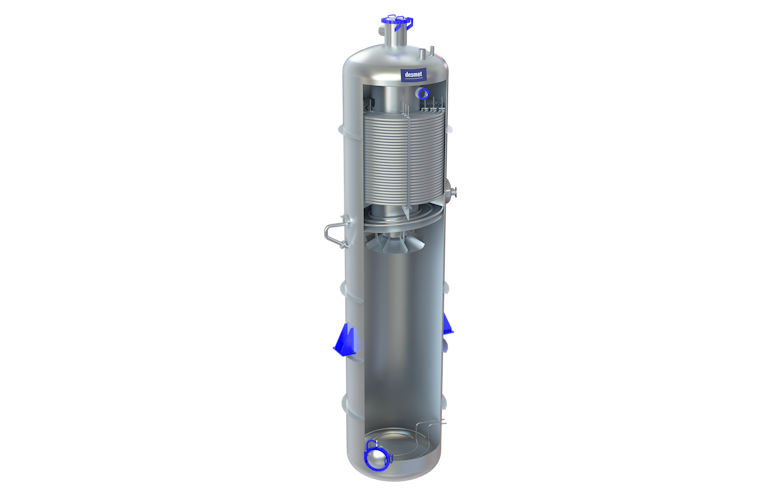
Continuous and batch bleachers in a large capacity range, to cover customers’ needs and optimal performance of the bleaching section.

Deodorizers
Continuous and semi-continuous deodorizers with a modular design and optimized heat recovery and excellent final product quality, adapted to the specific needs of your refinery.
Read more about:
Continuous deodorizer
Semi-continuous deodorizer
Dry Fractionation
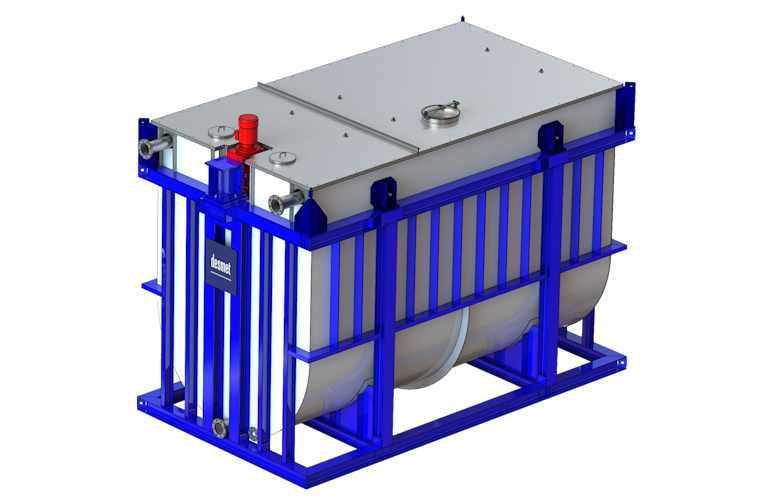
Desmet’s unique combination of crystallizers and customized press filters lead the fats and oils industry by offering the best combination of excellent heat transfer, optimal separation efficiency, low energy consumption seamlessly integrated with our own automation.